LibertyAndTruth
Liberty is Truth

Liberty and Truth is a connected body of work built on four claims. There is one objective basis for right and wrong: non-imposition, the only arrangement in which no one’s capacity to act is subordinated to another’s. The most widespread source of human problems is inadequate opportunity to obtain the means to act — time, resources, and know-how — which is produced collectively by the systems everyone participates in. Those problems persist because people reject information that threatens beliefs essential to their value structure. Consciousness takes place in a reality consisting of objects, motion, and affect within space and time, and all thoughts, feelings, and behavior are a product of Assignment, Sequencing, and Comparison of objects. The sections below summarize each, with links to the books and papers where they are developed.
If you want to browse the books they’re listed after the homepage material.
Morality
Morality represents principles and rules that people use to determine whether an act is right or wrong. It functions through self worth: a person who acts consistently with their morality sees themselves as something they like which feels good, and when a person perceives their actions as being inconsistent with their morality they see themselves as something they do not like which feels bad. Morality is a determinant of conscious motion and the acts that people engage in are influenced by what they believe is right and wrong, because it imposes costs through how they see and feel about themselves. (Objective Morality, Assignment Sequencing and Comparison) Morality is one set of values (producers of affect) that is determined by belief, but it is a good opportunity to identify the consequences of a person changing a moral belief. If someone’s acts throughout their life were governed by and consistent with a moral belief, to discover the belief is false and wrong, not only permits or forbids the conduct moving forward, and the potential to experience the feelings generated by that conduct, but it changes the way they see themselves through their history of adherence to it. Self deception is the central human problem, and this species is saturated in it because their beliefs are required to support their value structure. In other words, they must maintain their beliefs in order to feel good through the opportunities they have to act in their day-to-day lives. (Supremacy of Bias)
Morality only remains a topic of opinion because moral philosophy is intent on maintaining meaningless debates for the benefit of those involved in them that contribute nothing to humankind. (OM Paper)
Objective Morality
Being conscious minimally includes awareness, and awareness minimally includes opportunities to act to produce net positive affect, or to avoid negative affect. Different acts produce affect differently for different people, and often for different reasons, but each possesses the immutable desire to act. Each individual can act as he pleases so long as his acts do not interfere with the capacity of others to act. Acts that objectively interfere with others ability to act are categorized as physical (harm, injury, physical freedom), property (theft, damage, denial of use), threats, deception, and circumstantial (mostly systemic). The only arrangement that ensures that each has the capacity to act is non-imposition, because every other arrangement prohibits behavior that does not impose or permits behavior that imposes, authorizing the subordination of one to another. There is objective morality, and then there are countless forms of subjective morality where the subjective preferences of some number are imposed on others. (Objective Morality, OM Paper)
Circumstantial Imposition
For those who benefit from the present organization of human beings, on the surface objective morality works because they have the means to act, in the time, resources, and know how to do what they want to do and be what they want to be. For those who do not benefit from present organization they may recognize that an individual’s capacity to act is determined by the opportunities they have for time, to access resources (money), and what they know how to do. Time is a means to act because there are demands on time necessitated by the upkeep of our physical bodies. To act requires the time the act requires, the resources the act requires, and knowing how to perform the act. Where do an individual’s opportunities come from to obtain these means? They come from the acts of all others. Systems furnish circumstances, systems are a product of the acts of all others, and therefore systems that fail to provide adequate opportunity for its members to obtain time, money, and know-how impose on their capacity to act. Each individual participates for material or emotional benefit (indoctrination) or survival, and the acts for benefit restrict others capacity to act, in furnishing inadequate opportunities to obtain the means to act. Objective morality insists that people must abstain from imposing on the circumstances of others, which creates the duty to not contribute to systems that produce inadequate opportunity to obtain the means to act. The implication is that systemic function must supply all its members with adequate opportunity to obtain the means to act, obviously relative to what the system produces and relative to the opportunities of others. (Objective Morality, OM Paper)
This is not a basis for anti-capitalism, but the need to address political, social, and legislative elements that produce inadequate and trapping circumstances. (American Prosperity Proposals) It also doesn’t justify disadvantaged people imposing on others, since no individual is responsible for the circumstances of any other, and the act does not prevent or neutralize system imposition.
How People Perpetuate Economic Hardship
Inadequate opportunity is the most fundamental cause of human problems. Objective morality identifies it, and also identifies solutions. There are two legislative agendas in this country and neither one is interested in improving the circumstances of poor people in this country. The one distracts through the use of race, gender, sexuality, and class, and uses moral pretexts to gain consent for public spending by supplementing the consumption capacity of the poor. They’re supported by the industries, profit, and non-profit, who produce the goods and services provided to the poor. The poor remain poor because what they receive does not improve their means to act, the company gains the money for producing the goods and services, the politicians who ensure the spending and peddle the pretext gain the support of everyone downstream of the spending, and the poor remain poor with improved capacity for consumption which allows the cycle to continue. On the other side is the narrative that the nation is a perfect meritocracy, distributing opportunity and some are willing and able to take advantage of it and others are not. The narrative justifies why they have what they have and others have what they have without having to acknowledge that their benefit contributes to others’ detriment. (Ignorance and Stupidity: How Human Beings Perpetuate Widespread Economic Hardship)
Consequences of Circumstantial Imposition
The problem of inadequate opportunity is not limited to those whose circumstances are defined by the condition. Crime, drug dependency, random violence, and many other societal ills are produced by inadequacy of opportunity. In the development of values that produce public harm, as well as in devaluing risk and increasing the value of reward. Because agency (the capacity to act) is already limited by circumstances, the consequence is less significant because those living with inadequate opportunity have fewer opportunities than others that are obstructed by the consequence, and the gain is more valuable because it creates greater opportunities relative to someone who already has the opportunities the act provides.
The second pertains to how people tend to maintain their well being when opportunities are limited. As mentioned, moral standards are one set of standards among several categorical standards that influence how a person sees themself. How an individual views their performance and achievements also influences how they see themselves and produces positive or negative feelings based on whether they meet or exceed expectations. Fewer opportunities for positive achievements based on limited opportunity shifts opportunities for positive feelings from self worth to other standards. There are also subjective standards, not related to performance, achievement, or moral duty that a person must act consistently with or pay an emotional cost through a loss of self worth. There are also social standards, where self worth adjustments take place through the lens of how they see others as perceiving them. (Assignment, Sequencing, and Comparison)
One way a person with limited opportunities can create opportunities to improve self worth is through domination. Domination is a performance standard in meeting the expectation that they can impose their will on others. People with fewer opportunities are more likely to develop values to dominate others. Among a group where more have the desire to dominate, resistance to domination is prioritized for the same reason: seeing one’s self as being subordinated negatively impacts self perception, reducing self worth, and produces negative feelings. Resistance to dominance not only avoids the negative feelings associated with being dominated, but also produces positive feelings in the performance, and often morality. These are subconscious forces that commonly produce conflict and violence, and a person who has inadequate opportunity maintains their well being through self worth, and maintains their self worth through consistency with their standards, because they are limited in their ability to maintain it through activity due to a lack of means, and they cannot maintain well being through productive accomplishment due to means. A great deal of drug dependency is the product of lacking the means to maintain well being through activity, where drugs are an affordable means through which to maintain one’s well being in the absence of adequate opportunity.
Inadequate opportunity is a collective production, as an individual’s opportunities are the product of the acts of all others. Everything a person has an opportunity to do, where they can go, what they may use, opportunities for income, education, information, services and goods, are all determined by what everyone else does. Inadequate opportunity is like having lit dynamite moving around the public, and when it detonates it harms whoever is in the area. (OM Paper) When I see a city that has 132 homicides, 434 rapes, 1965 robberies, 6692 aggravated assaults, 2275 burglaries, 7546 thefts, 6400 stolen vehicles, and 639 non-fatal shootings I’m seeing a public who is harming itself through the maintenance of inadequate opportunity. This isn’t to say the acts are justified, or that inadequate opportunity causes people to become criminals. Many people were raised in and exist in environments with inadequate opportunity and never commit crimes, but inadequate opportunity increases the likelihood that a person will commit crime based in part on what I described above, in dominant anti-dominant perception and prioritization, and in reducing the consequence of risk, and increasing the value of the aim of risk.
The Root of All Human Problems
Adequacy of opportunity in itself would resolve many human problems naturally as convergent capacity produces convergent interests, in that everyone that has the capacity for preferred action seeks to protect that capacity and is less inclined to interfere with the capacity of others. Divergence in capacity tends to produce divergence in interests as those with capacity seek to protect it, and those with lacking capacity seek to obtain that capacity. The most fundamental human problem, and the barrier to addressing inadequate opportunity, is self deception. Earlier I mentioned the impact that moral beliefs can have on a person’s value structure, how changing a belief that supports a morality can change how a person sees themself for being consistent with it over a lifetime, where what they used to feel good about themselves for doing in the belief the behavior is right, if discovered to be wrong all those acts now carry negative affect or no affect at all, both of which produce decreases in self worth. Other values are also built on beliefs, and they determine what a person may do to experience positive feelings. (Supremacy of Bias) I commonly use the racial justice activist, and the upper class nationalist to demonstrate. If the racial justice activist discovers that systemic racism doesn’t exist, all the acts that they perceived as being right in the cause become meaningless, he loses a source of pride and self worth, and he can no longer derive pleasure from the relationships that rely on that belief, the activities he enjoys doing associated with the belief, and whatever material gains the activity may have promised. If the affluent nationalist discovers that his success is largely the product of the opportunities he was furnished with as opposed to superior ability, and the systems that produces his benefit produces other’s confinement, it changes how he feels about his accomplishments and others’ lack thereof. More importantly, without the justification that everyone is deserving of their position, it may change how he approaches life in general, what he can be, even his general aims, if he realizes his capacity to act has been furnished through a system that restricts the capacity of others. People avoid, ignore, and reject information, consciously and subconsciously to protect their value structure. This prevents people from learning things that challenge their beliefs, prevents communication from taking place because fact cannot be established, and has a negative impact on the circumstances of others, which is where it imposes, and how it produces the negative results that we see and experience.
In the age of information that we live in, the excuse that people are deceived no longer stands. In any area where a person is deceived if they are actually interested in the subject, contradiction between the deception and reality eventually becomes apparent. Information is presented to attract attention, presented through a lens and with omissions and emphasis that reinforce what people believe. It is only through the demand for deception that people remain deceived. The demand for deception exists because people prefer things to be as they want to believe that they are, as opposed to as they actually are. (Understanding Political Function Through Recent Political History, Ignorance and Stupidity, Covid-19 Media Project, Racial Perceptions) Challenging information produces a threat to values that feels bad and is avoided, whereas reinforcing information feels good in seeing one’s self as right or intelligent and improving certainty within one’s beliefs. Which is why my life is hell, because I provide the truth as it is, and instead of people confronting something that has the potential to collapse their perception of reality, they can simply ignore it or refuse to acknowledge it. (Journal, Florida Ordeal, Ava)
People are born into and exposed to beliefs that serve as the basis for value, producing positive or negative feelings. These beliefs are reinforced and built on to apply the consent of the public towards ends and interests that are not their own. People are puppeted through life developing passions about issues that are often irrelevant, that they do not understand, to support and promote the interests of a select few. (Ignorance and Stupidity) Nothing ever really changes because people want the problem and the solution to be what benefits them materially or emotionally, instead of what the problem actually is and what a reasonable solution looks like. Income in terms of distribution (proportions of the population) and what it buys has barely changed in the last 30 years, and it hasn’t changed in improving people’s capacity to act or improve their circumstances.
Addressing Inadequate Opportunity to Obtain the Means to Act
There are proposed solutions that either require no funds to enact, like the Round Up Service Charge Tax Credit Incentive, (American Prosperity Proposals) and other solutions like the Balance Stimulus that redistributes funds currently spent on providing consumption directly to the recipients. RUSC will improve the wages of people working retail, gas stations, fast food, and any other in person high volume transaction business by $5 to $15 per hour. The Balance Stimulus bypasses the political economy element of social spending where industry reaps the benefit providing goods and service to the poor, and provides funds directly to circumstantially trapped individuals giving them the means to overcome income impediments—allowing them to gain stability to plan effectively, purchase capital to bring a good or service to market, and improve human capital to enter a field or vocation of their choosing. (Ignorance and Stupidity) There are other solutions such as the Employee Termed Scheduling Tax Credit which scales back an existing tax credit (which may have additional indirect benefits) to incentivize employers to allow their full time employees to choose their schedule to free up time. Instead of a full time employee having to work five 8-hour days per week, they can schedule four 10-hour days, giving them 3 days off per week, or three 12-hour days, maybe two 16-hour days, or any schedule that doesn’t compromise their productive capacity on the job or safety that allows individuals to have more time. There is a huge difference in the capacity to act and in one’s mental state generally between working 5 days per week and working 3 or 4 days per week. (American Prosperity Proposals) These are among solutions that have no outlet largely because the public is too willfully ignorant to pay attention to them.
I brought up previously that people want the problems and solutions to be what they believe they are. The difference between myself and others is I identify how people’s assertion of problems are not consistent with the motion of the subject, the deficiencies of their solutions, and the material benefit to them and their affiliates that produce investment in their narrative. My assertion of problems has not been challenged and is evidenced through the results and the mechanisms that produce them. The target demographics are the beneficiaries of my solution, whereas the solutions of others primarily benefit the providers of goods and services that supplement the target demographics consumption, without providing opportunity.
Psychology Lacks the Framework
Psychology is a field that fails to recognize that behavioral tendency does not represent facts that constitute defect or disorder about the individual, but the relationship between an individual’s values and understanding and circumstances. Unchanging circumstances present recurring opportunities for the obtainment of positive feelings and the avoidance of negative feelings. Psychology lacks the framework through which the subconscious perceives and processes information, how objects are organized, objectives are prioritized, and decision making occurs. These processes have been identified and the implications are profound, not only in the potential for individuals to actually change their behavioral tendencies in so much as their circumstances permit, but also in improving intelligence through the conscious acknowledgement of what knowledge actually consists of, which is not determined by capacity for memory. (Assignment, Sequencing, and Comparison, ASC Paper)
Reality consists of objects, motion, and the affect that motion produces in conscious beings. Objects are defined by other objects, motion is produced by causes and is understood through cause and effect sequencing, and affect is the effect of motion including meaning or interpretation. All knowledge reduces to the definition and sequencing of objects, and everyone who is not suffering from physical cognitive defects has the capacity to identify and sequence objects. There are two main differences in intelligence. The first is the global inhibitor which is the degree to which one is committed to belief and what those beliefs are. As mentioned previously, a person cannot learn what challenges their beliefs because it feels bad, so self deception limits what people can understand. The second is also related to values. Intelligence develops as a byproduct of objectives, and objectives are created based on the positive feelings they are believed to produce. A person whose objectives are achievable without the development of intelligence has no reason to develop advanced intelligence because what he does in life does not require it. As for heritable intelligence, values are heritable, a person is genetically predisposed to like and become interested in certain things that exist in their environment. There is no way for heritability to distinguish between heritable values that produce objectives and interests that lead to the development of intelligence, and any innate predisposition for intelligence itself. Given the nature of reality and perception, there is no fundamental difference in the capacity for intelligence between people. (Assignment, Sequencing, and Comparison)
Public Education
Public education conditions authority, scheduling routine, introductions to ideological indoctrination, suppress critical thinking, and create aversions to study through excessive exercise and curriculum that often has no practical value to most individuals who learn the material sufficiently enough to pass the class but neither retain it nor do they need to retain because they’ll never use it again. Public education is also paced according to the curriculum as opposed to paced according to the individual, leaving most students ahead of or behind the material. I do have an outline for public education reform, but the scope is comprehensive and requires a team that I do not currently possess. The scope is policy (compulsory schooling in the obtainment of a basic education, to allow for early specialization), operations (how schools function), and curriculum (basic education consists of what an individual needs to know to understand everything else, and what the public requires the individual to know to understand how to interact in public life).
A basic education that would exceed in utility what K-12 currently offers could be achieved in K-8. The basic education can be taught at a student’s own pace, meaning the student is incentivized to complete a finite amount of learning, instead of being detained by the pace of class that is constructed to cover the duration of the school year, as opposed to what a student needs to understand about the subject. A student who completes basic education can begin specialization or vocational training in high school. For those who want to attend universities they can choose classes that are required for that specialization, and avoid the classes not required, that they may not be interested in, and that may impact their academic performance in the coercion to learn non-applicable material. Only 42% of jobs in the US require a 4 year degree. Meaning 58%, or most jobs, do not, which raises the question of why students in this country are compelled to complete classes to learn material that only serves as a requisite for higher education that has no utility to them, or no utility to the public in them having learned it? The vocational route can include a year of vocational training, followed by a year of on the job training coordinated between businesses and the school if the training required isn’t too extensive. Of course there are longer routes depending on where the student’s interests are, a machine operator, a mechanic, tradesman, nurse, business management, among others are routes that vary in the requisite knowledge to begin the training, as well as training to develop skills applicable to the job.
Organization reform seeks to address the authoritarian structure of schools and recognize that the students are not citizens to be molded, but people who demand education that the school is supposed to supply in accordance with the general desires of the student body. I won’t attempt to summarize what the organizational reform looks like because the details provide the full picture, but the organization must function through the preferences of students moderated by the administration, not the arbitrary authority of administrators and teachers. Some organization reform pertains to the teaching approach itself to accommodate a pace based curriculum.
The hold up is the curriculum itself. It requires going through subjects by grade and lesson, and determining what information is required based on the criteria that it is needed to understand everything else or something the individual should be responsible for knowing as a member of the public, and then also creating new lessons, and adding additional subjects. It also requires removing material or changing how material is presented that persuades towards an ideology or subjective valuation. All added material must be accompanied by its role in being essential for someone to understand everything else, or in being required to function among the public.
Deity Worship
As for a specific belief that limits intelligence, none is more pervasive than deity worship. It grounds valuation and understanding in authority, it establishes that the deity and not people determine outcomes on this planet which allows magic (the deity’s power) to serve as the explanation for happenings, and it produces objectives to appeal to that magic as opposed to understanding problems to apply solutions. It attempts to impose the deity’s subjective preference onto others, it reduces morality to authority based reasoning, imposes a morality that is not ideal and internally contradicting, it corrupts moral functioning by prioritizing appeals for forgiveness over understanding what produced the behavior, it stratifies people into categories of good and evil, and it precludes people from understanding anything that challenges the existence or rightfulness of the deity. (Objective Morality) Deity worship changes moral processing to the degree that an individual is invested in the deity, where the negative feelings that come from seeing one’s self as having perpetrated a wrong act have less to do with understanding what they did was wrong, and more to do with how they perceive the deity as perceiving them, causing morality within deity worship to function more like a social standard than a moral standard. This is of course why forgiveness is prioritized over understanding the act, because the belief that the deity has forgiven them restores self worth, as opposed to understanding creating distance between the version of themselves who committed the act and the modern version who is operating out of superior understanding.
Deity worship is a tool used to suppress fear, and to convince one’s self of control over circumstances they have no control over. It takes root through the emotional response associated with the ideas of the religion. The idea that a person is loved by the all powerful deity, that they are important to him, that he suffers for them, forgives them, and protects them, produces positive feelings, through adjustments to self worth. Stories, principles, and ideas produce emotions that are assigned as value to those objects. These internally produced feelings are often used as evidence of the deity. A person prays, he perceives himself as communicating with a deity who can help him and that idea produces a positive feeling, and the person attributes that positive feeling while praying to the deity. Or a person is thinking about the deity, they understand a scripture, or think that the deity secured them some outcome, and experience a positive feeling that to them is evidence of the deity. Anything attributed to the deity that produces a positive feeling has the potential to serve as evidence of the deity. (Assignment, Sequencing, and Comparison)
Deity worship holds the fundamental contradiction that the deity created human beings because he knew he’d love them, while threatening that should they refuse to worship him and subject themselves to his authority they will be tortured forever. According to the doctrine, over time the only thing that will exist is heaven and hell. Which means the deity created existence to satisfy his desire to control and torture, because he has both power and knowledge of the outcome he’s producing. Motivation is apparent in that he can produce any outcome he chooses through supposed all knowledge and all power, and he chose to produce one in which people are reduced to being his subjects or being tortured, which means he is motivated by the desire to control and torture.
Fundamentally, what deity worship is is the worship of power. Religion serves as the medium through which that power may be accessed, and prescribes what one must do to access the power. There’s no evidence that any result on this planet has been supernaturally produced, and even what believers claim was supernaturally influenced (answers to their prayers, coincidence, or unlikely favorable outcomes) are always delivered through natural means. The deity does not help anyone in life. As for forgiveness upon death that also does not work based on what morality is, and what the religious lack. Morality is a determinant of conscious motion, absent circumstantial influence it determines an individual’s potential for motion along one of two lines. The first is subjective, where morality is determined by authority, and that authority prohibits conduct that does not interfere with the agency of others, compels conduct that does interfere with the agency of others, and or compels the agency of others towards ends that are not their own. There is objective morality, where no individuals acts interfere with the agency of others, and therefore all are free to act as they please, or there is subjective morality which limits or compels the capacity of others to act for no benefit beyond the satisfaction of authority. Simply forgiving people who engage in wrong acts doesn’t change the fact that they do not know right from wrong, and as such, forgiveness produces an environment of eternal conflict. (Objective Morality)
The fundamental difference in moral orientation amounts to the desire to control others or not to control others. The deity is minimally evil, because the claim is that he is all knowing and all powerful, but produced an arrangement that is unideal to satisfy his desire to control and torture. More likely the deities do not exist. Internal and external contradictions, subjective moral codes, no evidence of the ability to exert any influence over physical outcomes, and the obvious incentive for religions to use a deity to impose subjective preferences onto the population.
Ideal Existence
Ideal existence is very simple to ascertain, based on the aims of consciousness, moral duality, unlimited capacity, and what the universe does. (Objective Morality, 5 Possible Conditions of Existence) The universe is a random generator of complexity, beginning with basic elements and through natural processes produces more elements that form complex structures like planets, that form more complex structures like life and intelligent life. Why would anyone need a random generator of objects and consciousness? If beings exist forever in an objectively moral setting they possess the desire to act which reduces to creation and experience, and over time they exhaust all novelty because they are limited to known objects. The solution to this problem is a random generator of objects and life which is exactly what the universe is. Consciousness probably survives death, and if it does, consciousness will be sorted by moral orientation, to allow the subjectively moral to continue to compete for control of one another, and for the objectively moral to continue in creation and experience, while contributing to existence itself through their continued creation and experience. One space is incompatible to accommodate both moral orientations, as the desire of those to control is in constant conflict with the propensity of the objectively moral to prevent and neutralize imposition. (Objective Morality, 5 Possible Conditions of Existence)
I have no evangelical ambition for ideal existence. It is a better explanation than any other and is consistent with observation and logic. More importantly it makes no claim on behavior, it states what is if existence is ideal, and it falsifiable by virtue of presenting an aspect of it that is not ideal. It also means it doesn’t matter if a species never makes its way out of subjective morality, because the objectively moral space still benefits from the experiences they have and the objects they create, it just means fewer survivors to an objectively moral space, and objective morality respects their decision to compete for control of one another, or to be controlled by an authority. Ideal existence is knowable, and the question to the deity worshipers is how they can believe in a deity who is all knowing, and all powerful, but would create an existence that is unideal?
That represents the general themes of the material on this site, although it is by no means the total breadth, as material also consists of common misconceptions associated with the general mechanisms and organization of society that rely on them. Every intelligent species that will ever exist either arrives at objective morality which identifies and provides solutions for their problems, or they do not, and they remain self deceived and deceived, and in conflict through contention for control of one another, individually and factionally.
Books are available for free download, use code: free10 . Of course if you’re interested and can afford it I can use the $10, but if you cannot or are not $10 interested use the code.
Together, these books argue that human problems stem from self-deception, reinforced by systems of power that exploit it. They combine theory with lived experience, exposing mechanisms of belief, systemic corruption, and economic control — while offering both critique and proposals for a more truthful, liberty-based society.
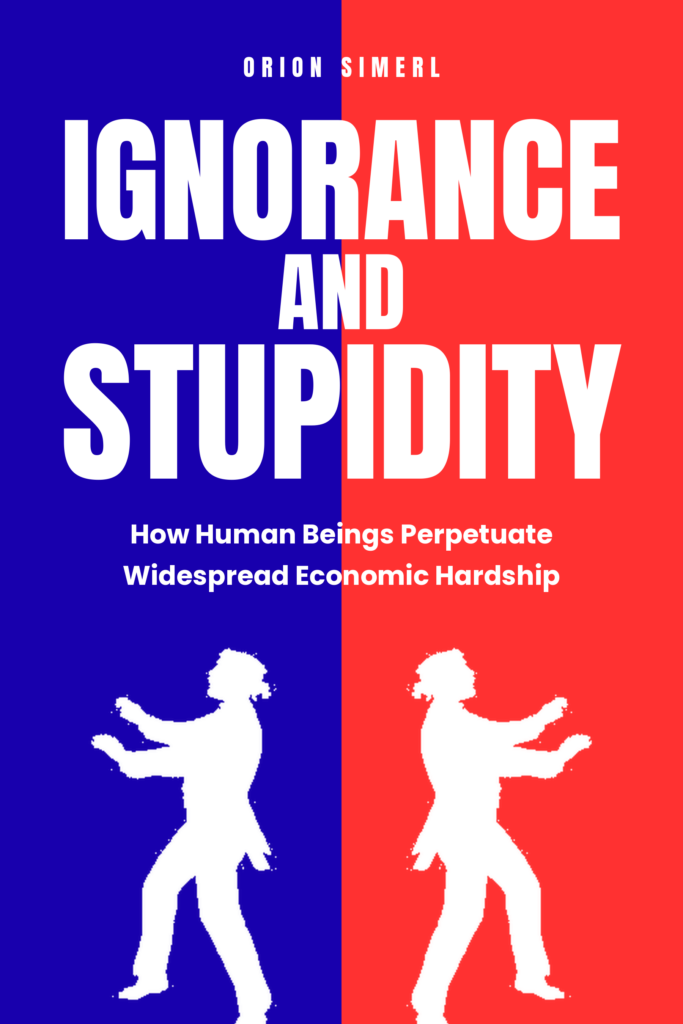
Ignorance and Stupidity: Every dollar of public spending runs a circuit. A moral cause — housing the homeless, sheltering migrants, feeding children — wins the public’s consent to spend. The spending flows to the companies and organizations that supply the services, who return their support to the party that funds them, which gives the party every incentive to keep the money moving and the cause alive. The problem is never solved, because a solved problem would break the circuit. Print Edition Available on Amazon.
This book follows that money through New York, California, and Minnesota, and then asks the harder question: why does a public that pays for all of it, and could see all of it, choose not to look? The answer is the subject of the title, and it implicates everyone.

The Supremacy of Bias Orion Simerl explores the hidden psychological forces that make us cling to our beliefs, even when confronted with clear facts and reasoning. Through the lens of value protective denial — the tendency to reject information that threatens our sense of identity or self-worth — Simerl reveals why meaningful dialogue so often breaks down.
Drawing from real social media debates on topics ranging from economics and politics to religion and morality, the book shows how bias not only distorts individual thinking but also undermines collective problem-solving in society. Each exchange is carefully analyzed to expose the mechanics of avoidance, denial, and rejection, making abstract concepts vivid and relatable.
This timely and provocative work is more than a critique of online culture — it is a call to recognize how bias shapes our choices, our politics, and even our relationships. By understanding these dynamics, readers can begin to reclaim the possibility of honest communication in an age of polarization.

The American Prosperity Proposals In American Prosperity Proposals, Orion Simerl argues that many Americans are not held back by a lack of effort, but by circumstances that deny them sufficient time and money for effort to matter. Rejecting emotional appeals and ideological prescriptions, the book presents a practical, incentive-driven approach to reform.
Through proposals such as the Round-Up Service Charge, the Balance Stimulus, Employee-Termed Scheduling, and Centers for Economic Planning, Simerl shows how opportunity can be expanded without undermining markets, productivity, or individual liberty. Each proposal addresses both economic mechanics and political reality.
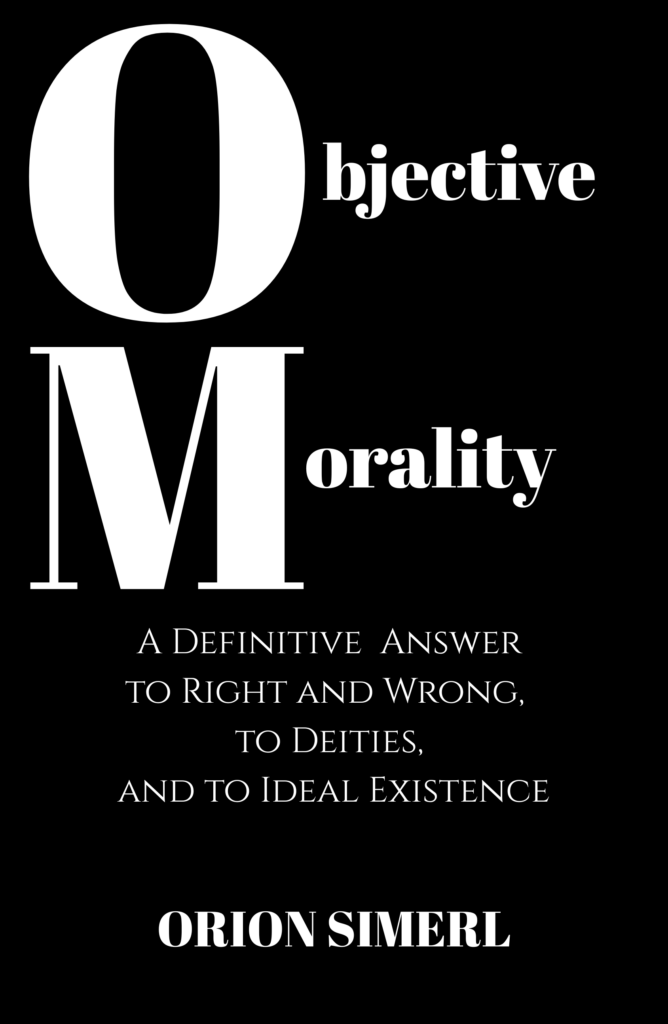
Objective Morality: A Definitive Answer to Right and Wrong, to Deities, and to Ideal Existence, grounds moral judgment in the universal structure of conscious experience. Every conscious being, by definition, desires — and the only arrangement in which all desires can be pursued simultaneously is one where no individual imposes on another. From this structural fact, the book derives objective morality: non-imposition as the singular criterion for right and wrong, applicable across all circumstances and independent of cultural variation, religious authority, or subjective preference.
The first half develops this framework systematically. It identifies five categories of imposition — physical, property, threats, deception, and circumstantial — and explains how collective systems that deny people adequate access to time, money, and opportunity constitute indirect imposition even when no single actor intends harm. It also examines the mechanics of moral psychology: how morality functions through self-worth, how subjective moral systems operate as instruments of control rather than objective standards, and why the distinction between objective and subjective morality has consequences for every domain of human life.
The second half applies the framework to the major world religions, evaluating their central tenets against the standard of liberty. It then extends into metaphysics — examining what objective morality implies about the nature of any creator, whether consciousness survives death, and why the universe, understood as a generator of novelty and complexity, may represent the solution to a problem inherent in eternal existence. Available in print on Amazon.

The Florida Ordeal is the record and preface to a trip to Florida that resulted in 2 felony charges and 4 misdemeanors for the possession of less than 3 grams of marijuana, 4 10mg gummy edibles, and a pipe with marijuana residue. The book chronicles my experience going to court and how I was able to use the leverage of misconduct by the public defender and the judge to achieve a favorable outcome.

Understanding Political Functions Through Recent Political History 2019-20 Understanding Political Functions Through Recent Political History by Orion Simerl reexamines the U.S. political system as one structurally designed to serve elite economic interests rather than popular will. Extending the tradition of Charles Beard, C. Wright Mills, and Thomas Ferguson, the book integrates historical analysis, political science theory, contemporary case studies (2019–2020), and personal observation.
Its novel contributions include reframing the American Revolution as dependent on mercenary enlistment rather than patriotic ideology; interpreting expansions of suffrage, civil rights, and social programs as system-preserving concessions rather than democratic triumphs; and extending Ferguson’s “investment theory of politics” into present-day policy debates on taxation, healthcare, and climate change. The book further advances original critiques of the opioid epidemic as demand-driven, proposes unconventional resolutions to entrenched conflicts such as Israel–Palestine (“The Option”), and introduces institutional innovations such as Centers for Economic Planning and the Organization for Popular Legislation to counterbalance industrial dominance.
By combining structural critique with forward-looking proposals, Simerl offers both diagnosis and remedy. The work contributes to scholarship on political economy, democratic theory, and U.S. constitutional history, while engaging general readers through its polemical clarity and contemporary relevance.

Racial Perceptions: Addressing Popular Misconceptions that Contribute to Racial Divide challenges prevailing narratives of systemic racism in the United States by reframing disadvantage as primarily a function of economic inequality and class position. Through a combination of high-profile case studies (e.g., George Floyd, Jacob Blake, Breonna Taylor, Rashard Brooks), statistical analysis, and personal experiences with law enforcement and the justice system, the work argues that disparities commonly attributed to race are more accurately explained by socioeconomic conditions.
The book critiques the use of racial framing in media, politics, and academia, suggesting that selective interpretation of data reinforces division while obscuring class-based causes of inequality. It advances the claim that, while historic systemic racism shaped patterns of disadvantage, present-day disparities persist mainly through income inequality, cultural influences, and geographic context rather than ongoing racial discrimination.
By integrating quantitative data with qualitative narrative, the text provides a provocative intervention in debates on race, policing, and justice. Its central contribution lies in challenging readers to distinguish between systemic racism as a historical reality and class-based inequality as a contemporary determinant, thereby encouraging a reframing of policy and public discourse around opportunity rather than race.

Covid 19 Media Project: Identifying the Interests and Tactics Used to Create Hysteria establishes the risk of being infected with covid 19 and contrasts that risk to the risk being projected by the media and politicians by reviewing 7 popular news articles from the beginning of the outbreak. The main conclusion is that COVID did not represent a threat to public safety to justify police powers to impose on the rights of citizens, and danger was intentionally exaggerated to serve the interests of the media, politicians, industry, and others at a detriment to the public.

Assignment, Sequencing, and Comparison advances a unifying framework for cognition by identifying three irreducible processes—assignment, sequencing, and comparison—as the foundation of all subconscious activity. Its novel contributions are:
In sum, ASC contributes a parsimonious yet comprehensive account of cognition that explains decision-making, standards, denial, and intelligence within a single framework.

Ava Kali Simerl died on December 6, 2024. She was nineteen.
This book is her father’s account of what happened and his attempt to answer why. It opens with the phone call, follows three days in the ICU at Froedtert Hospital through the organ donation process, and sets out what the available evidence actually supports about the decision — that it was not the product of a life she wanted to escape, but of one night, alcohol, and a train of thought she could not get out of.
The largest part of the book is not written by him. Ava in Her Own Words reproduces two and a half years of the text log between father and daughter, beginning when Ava was sixteen and ending about a day before her death. It is included so that the reader meets her directly rather than through description, and so that the analysis that follows can be checked against the record instead of taken on trust. Screenshots of the full log are available for verification.
The surrounding chapters take up what the event raises: what a suicide means under each of the three general accounts of existence, why the Christian consolation offered at the time fails on its own terms, and what the author concludes has become of his daughter.
This is not a grief memoir and it does not offer the usual consolations. It reasons from what can be observed toward what is most probable, applied here to the author’s own daughter.
Contains detailed discussion of suicide.

Titled The Oubliette, the journal spans from 2017 to the present — roughly 800 pages of entries covering political and legal analysis, the mechanics of daily survival without stable housing, the development and failed promotion of the material collected here, and the application of objective morality to events as they occurred. It documents the conditions under which this body of work was produced, which are inseparable from what the work argues. Click the image to access the full journal.
A biographical overview outlining the personal experiences and intellectual progression underlying Simerl’s work in philosophy, cognition, and public policy.

The Organization for Popular Legislation (OPL) is built on the premise that public policy in the United States is shaped not by the will of the people, but by the industries that finance the two major political parties. These parties, the argument goes, consistently prioritize the interests of their investors, leaving the bottom half of income earners without genuine representation.
Recognizing that many congressional districts are decided by relatively small margins of 10,000 to 20,000 votes, OPL seeks to concentrate voter influence in these swing districts. The strategy is to organize pledges and collective voting power, making it clear that legislators’ careers could hinge on whether they adopt or reject OPL-backed policies. Through this leverage, OPL envisions shifting legislative priorities from party-aligned investors to policies that materially benefit ordinary people.
Several papers derived from this body of work are currently under review or in preparation for submission to peer-reviewed journals. These include work in moral philosophy, cognitive psychology, and public policy. Preprints of select papers are available for download through the link above.
Click Image to View Product Description


More Products Coming Soon.